Saturday, 19 April 2014

Blighted by failure

Here's the thing.
I have had allotments for more than a decade. I love growing stuff. Mostly I manage to make stuff grow! But I am hopeless at growing potatoes....
I always have an excuse - it's too hot. It's too cold. It's too humid. my soil is too clay. Too acidic. Not acidic enough. They were cheap seed potatoes. But actually, between ourselves, I just don't seem to have the knack.
Every year I try a different method. Trenches, wrapping them in newspaper, manuring, not manuring,  throwing in a few slug pellets.....
Doesn't make any difference.
 My potatoes get blight or refuse stubbornly to flower. Or some horrible beastie puts precise holes all the way through the middle of each potato. Or slugs just gorge themselves on the whole crop.
Bwwwahahaha lads, she's going to try growing us again!
Now, don't talk to me about your fancy-pants potato-sack growing system, they DO work and i have managed to grow a couple of pounds worth of salad spuds in them but they are more of a ''grow something on your patio'' sort of thing. And don't flaunt your lovely raised beds at me - I don't have the money to buy them or the expertise to make them.
I have an old-school allotment, with masses of soily space, crying out to be filled with row upon row of perfect potatoes.
But come harvesting time, I am always doomed to disappointment.
On the other plots all over the allotment, people gleefully wheel their barrowfuls of perfect pink-blushed potatoes, super-sized spuds and beautifully brown bakers, ready to store over winter and help fulfill that fantasy of urban self-sufficiency.... Not me. Ah no. I manage a panful of pathetically tiny, stunted ones which will be the size of marbles by the time I have pared the damaged bits off.
Then - no matter what variety I go for - the potato will remain rock hard when cooking before suddenly in a split second, reducing to mush.
The other month I bought a massive sack of potatoes in a well-known discount supermarket for £3.99. We are still wading through them and they have proved fabulously versatile in cooking.
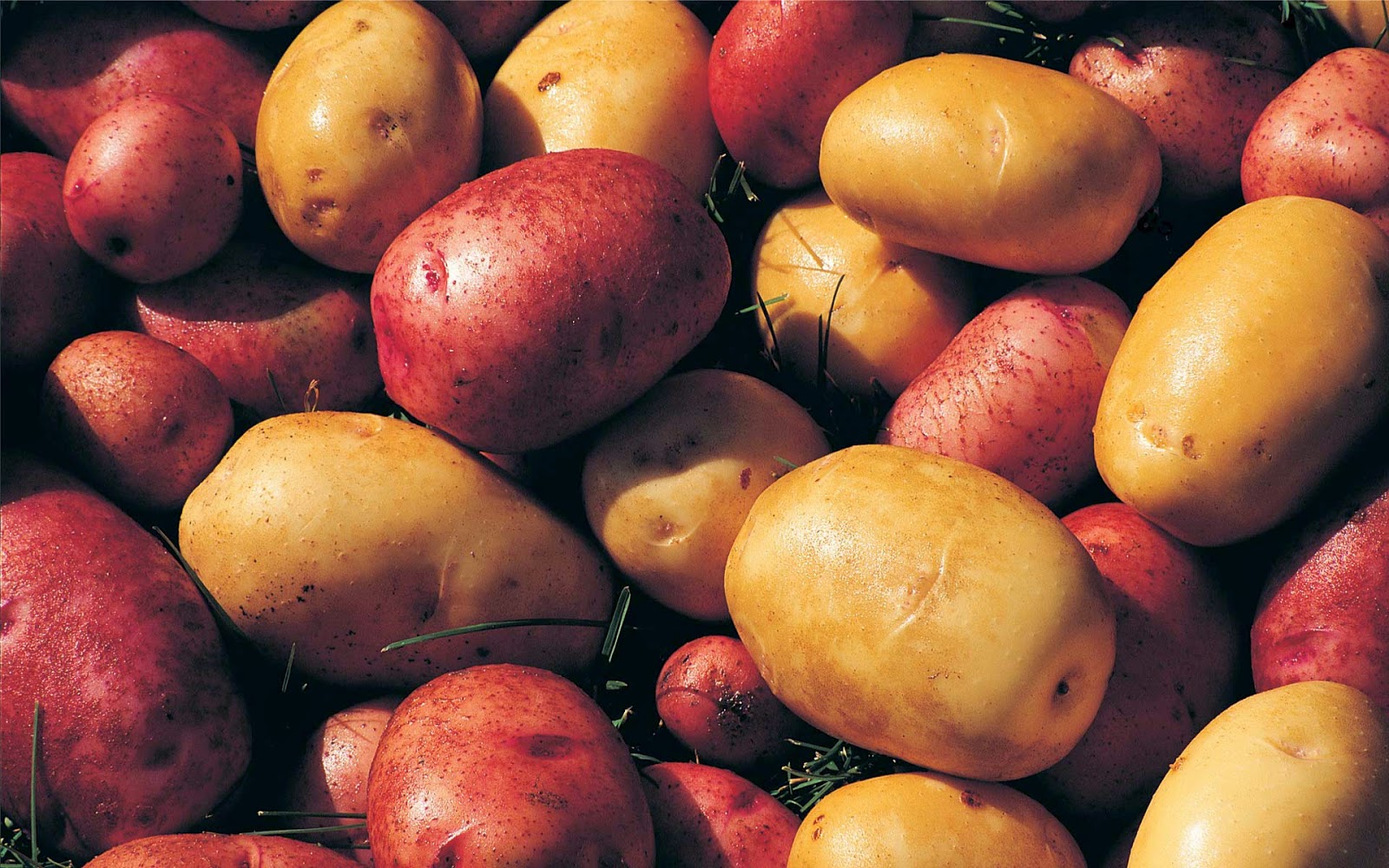
Perfect potatoes - The Dream.....
I compare that to the £5.99 I have spent on 20 seed potatoes - guaranteed to be blight-free, eel worm free, easy to be grown by idiots. They even helpfully enclose a How To guide.
I have read it carefully and in a triumph of optimism over experience, planted them out yesterday on Good Friday, in keeping with gardener tradition.
I'll let you know......!


Saturday, 5 April 2014

Seeds the day...

'April is the cruelest month, breeding lilacs out of the dead land, mixing memory and desire, stirring dull roots with spring rain. ' - TS Eliot

Frogs porn on my pond!
I do so love Spring, it is so full of promise.
Will it be a warm May? A spectacular summer? Will it be a fruitful season with a cornucopia of crops and floral-abundance? Or will we spend the next few months shivering in the greenhouse as we watch relentless rain filling up the lovingly dug plot, planted with such high hopes?
 It doesn't matter; Spring is a beautifully-wrapped gift waiting to be revealed and that sense of excited expectation is part of the fun.

The birds are full of purposeful activity in the mornings, my body is getting used to that loss of an hour's sleep and beginning to love the later lightness of evenings. Tender baby leaves are unfurling on my fruit trees and bushes. The filthy little frogs have filled my pond with spawn after a noisy and frantic orgy! And the spring flowers are making the neglected corners of the plot look alive and loved.

Never mind that the last five days have been misty and moisty with Saharan smog, and flat grey skies. Never mind that I have a streaming cold...
I have seeds! And seeds mean a flurry of activity,with the promise of so many good things to come.

Ready, steady...grow!


Might have overdone it a tiny bit on seeds....

Sunday, 23 March 2014

Free lunch - grasp the nettle!

This time last year it was snowing! Can you believe it? 
Exactly a year ago I was sitting at my pc, watching fat flakes fall softly on my little back garden and wondering if I'd ever get anything started on my allotment.
This year, we have been blessed with a super sunny March, and though today's wind has an icy edge to it, my two-hour dog walk this morning was a proper tonic for the soul.
The birds were in fine voice, I heard woodpeckers, the woods were beginning to smell all fresh and garlicky and I decided to harvest a free lunch, to prolong my time in the sunshine.
Nettles! Not strictly a crop which I grown on my allotment (well, not intentionally!) but I do love to take advantage of free food whenever and wherever it presents itself!
And on such a gloriously verdant Sunday, positively pulsating with Spring-iness, it seemed appropriate to go home and make nettle soup.


Nettles are supposed to be extremely good for you, too. They're credited with helping detox the kidneys, improving the immune system, lowering blood pressure and aiding sufferers of rheumatism and arthritis. I've even heard claims that nettles are good for the libido too, but given they are abundant in Spring, when the sap rises, maybe that's just...coincidence ;)?
Anyway, I'm partial to the earthy, almost citrussy tang of nettles!

To pick the prickly little pesky plants you will need a pair of gloves and a carrier bag.
Pick only the young fresh nettle tops . Feb/March are the ideal months for nettle - any later and they get stringy and tough. And definitely not when in flower. You can also steep dry or fresh leaves in boiling water to make a healthy tea or add to stews/soups etc later. Or blanch them and try as a pesto. Hugh F-W suggests using them as a spinach substitute in spanakopita...I must try and make this sometime.

There are loads of recipes out there - from witchy brews to more mainstream chefs such as Jamie Oliver.This is the one I use - sweet and simple.
It's a rich spinachy green and earthy and velvety to the taste.
Ingredients
Around 150g nettle tops
A decent knob of butter 

1 onion, peeled chopped

1 medium leek, finely slice
1 small potato chopped.
A celery stick, chopped
A tablespoon of white rice, like basmati 
1 litre vegetable stock 
salt and pepper 
Some double cream to swirl in! 
Method
Pick over the nettles - gloves on! Wash them thoroughly and remove tough stalks. you're just using the tips really.....
Melt the butter in a large pan, add the onion, leek, potato celery and garlic, cover and sweat for about 10 minutes, stirring a few times, until leeks etc are soft.
Add rice and stock, bring to a simmer and cook for 10 minutes.
Add the nettles, stirring them into the stock as they wilt, and simmer for five minutes or so, until the rice and the nettles are tender (very young nettle tops will need only two to three minutes).
Season with plenty of salt and black pepper.
I like to swirl in some double cream and chopped herbs to serve. I dare say natural yoghurt would work as well!


Sunday, 12 May 2013

Rhubarb, rhubarb. . .

So Mother Nature has finally caught up a bit, though temperatures still seem cool for May.
The plot is definitely looking perkier and I'm feeling more confident about getting some good produce this year. There are seedlings and plantlets abounding in the greenhouse and all we Northern gardeners are just waiting for the threat of frosts to disappear. 

If nothing else, we've been enjoying the fruits of my labours <<d'you see what I did there...?>>  - every plot holder's best friend - rhubarb. 
After last time writing about chilis - a vegetable which is actually a fruit, today I'm singing the praises of a fruit which is actually classed as a vegetable....
At a time of year when there's not a huge amount of options to harvest, rhubarb's beautiful  huge leaves  make a corner of your plot look abundant. And oh, the joy of parting those monster leaves to find spears of pinky loveliness, all waiting to be transformed into treats!
OK, by the time you've added enough sugar to stop your cheeks turning inside out with the sourness, there may not be a great deal of nutritional value in rhubarb, but it is such a stalwart, low maintenance, fail-safe crop, easy to grow and with lots of culinary uses. It's also known to be a useful laxative.!
So over the years, we have gorged on crumbles, with residual syrups then frozen to make ice lollies for the children; I have experimented with rhubarb in cake - highly recommended and delicious served warm with cream; I have made rhubarb-infused vodka, to be served with ginger ale as a sort of Yorkshire mule cocktail! 
And this year, my cupboards are now full of beautiful, dark red, ginger and rhubarb jam.
I haven't been caught eating it out of a jar with a spoon. No, no, that must have been someone else.....
jam-tastic!

You can also use the leaves - which are toxic to humans and some animals - as a spray for aphids and other sucking insects, as it suffocates them. 
  • Use 1kg of leaves and 2 litres of water.
  •  Bring to boil and simmer for around half an hour.
  • Strain off leaves
  • Dilute to use as a spray.

This does need to be used fairly quickly as its effectiveness apparently wears off if stored.


There's some fab other uses and interesting info about rhubarb on this site, which I stumbled upon while looking up using rhubarb leaves as a hair dye...


Friday, 22 March 2013

Chill out!

We've just marked the vernal equinox, the first day of Spring!
Ah, Spring - that season of increasing daylight and warming temperatures and the rebirth of flora and fauna......

Only nobody seems to have told Mother Nature this.

 It's snowing heavily as I type. It has snowed on and off for days. Now, I'm normally a big fan of snow - it's far prettier than rain, you can have fun in it and watching snow falling is one of life's dreamy pleasures as far as I'm concerned. But now, the lustre is wearing off for me.
Even the children are getting bored of the white stuff.
This has been the coldest March for 10 years, possibly longer. The daffs are still tightly budded, the crocuses haven't bothered unfurling, snowdrops are still in bloom and there seems no end in sight.
And my expectations for the coming growing season are somewhat low! Nothing in the unheated greenhouse is germinating, and the outside ground is sodden and will be for some time yet. It's rather frustrating.


So I am trying to make myself feel a little warmer by focussing on what's happening on my window sills at home.

Chillies. Easy to grow and so many uses! We're great fans of the lovely little  fruits!
The plants with their tiny white blossoms are attractive in their own right, and then when you have your own little chillies forming....!
All I can think of is wonderful things to cook - chilli chocolate brownies, salsas, chilli infused oil, curries, stir fries, nachos, pizza toppings, chilli jam, arrabiata sauce, all studded with flecks of  flavoursome red. Chillies are so useful and we are addicts.
I know there are loads of different colours, varieties and strengths, but this year I am concentrating on jalapeƱos  as they are the most versatile for my needs.

I'm also starting off sweetcorn, tomato, broad beans, sweet peas and broccoli on my son's 'magic' windowsill. His room is the warmest in the house and although not south facing, seems to gather the most light.

How are you other allomenteers staving off the long winter blues?


Friday, 1 February 2013

Dormant


''A dormant seed is one that is unable to germinate in a specified period of time under a combination of environmental factors that are normally suitable for the germination of the non-dormant seed. Dormancy is a mechanism to prevent germination during unsuitable ecological conditions, but the probability of seedling survival is low.

One important function of most seeds is delayed germination, which allows time for dispersal and prevents germination of all the seeds at same time. The staggering of germination safeguards some seeds and seedlings from suffering damage or death from short periods of bad weather or from transient herbivores; it also allows some seeds to germinate when competition from other plants for light and water might be less intense. 

Another form of delayed seed germination is seed quiescence, which is different than true seed dormancy and occurs when a seed fails to germinate because the external environmental conditions are too dry or warm or cold for germination. 

Many species of plants have seeds that delay germination for many months or years, and some seeds can remain in the soil seed bank for more than 50 years before germination''
It has been an embarrassingly long time since I last visited this blog. And with such a fledgling blog, it is probable that any readers have long since wandered off to admire someone else's plot.
 If you're reading this, well hello! 
Pull up a plastic patio chair, and I'll crack open my flask of tea to share :) 

 Why the long, long absence?
 I've been dormant.
 The last year has been really challenging - practically and emotionally, but I'm here, I've survived. 
I'm ok and I'm ready to start a new season. 


 It was a hard year on the plot too - bad weather, poor crops, a paltry harvest; not much reward for the mud sweat and tears we allotmenteers endured. But having my Eden to escape to has nonetheless, been a godsend. 
 Peace. Fresh air. Hard physical work. Grounding. Mindfulness. And mind-fullness. While I'm on my plot, there is no room in my head for all of the external stresses and anxieties. 
There is just me. The elements. The earth. Some worms. And sometimes a robin....:)

I went down to the plot several weeks ago - the first time since Christmas. It was in pretty good shape considering; I had worked hard in Autumn to clear the decks, prune back, tie back, all ready to kick back over winter!

 In a spirit of optimism, I sowed some sweet peas seeds in the greenhouse. 
Then the ice and snow came...and I didn't get round to watering them. 
January passed with plummeting temperatures, frost-bound earth and blanketing snow. And latterly, a swift thaw which left the plot under water in places. 

But tomorrow, with a milder, calmer day forecast, I will venture down to see if by some miracle they have germinated. And heartened by the sudden arrival of snowdrops and crocus, I will sit in the greenhouse, pretend it is spring, sow some more seeds and look forward. 

 Brighter days are coming. . .
The first crocus


Thursday, 27 October 2011

Gin and bear it!


I have just finished making this year's batch of sloe gin.
I'm sure you've tried it. If not, you must come round and have some of last year's!
It's a garnet, syrupy sweet and tart explosion of taste, followed by a deep warmth which creeps through your veins - just the thing to warm your cockles in winter.

There are no sloes on my allotment, but I'll be taking some of last year's brew along to our next allotment get-together around Bonfire Night to share. It's a sure-fire way to win new friends :)

I found several bushes bursting with fruit along a cycle path next to the railway. If you've not seen sloe bushes before, you'll soon learn to spot them.
Sloes are the fruit of the blackthorn bush - small, bluey-black fruit, with a stone at the centre and so sour they will turn your mouth inside out. And protected by spiky branches. Why bother? But add sugar and gin,leave for several months in a dark place and they obligingly transform themselves into one of my favourite liqueurs.
There are a hundred different recipes out there. Hugh Fearlessly Eatsitall is usually pretty reliable if you like a proper recipe. Here's what I do.
a) Wash the sloes to remove any pollution/bugs etc
b) Freeze them to save all that pricking faffle. Or prick each sloe individually to allow the juice to seep out....Use defrosted sloes to make gin, not while still frozen.
c) Use 1lb of sloes per 8 oz of sugar and litre of gin.
d) Bung them all together into kilner jars. It is easier to fill them, shake them and remove the sloes later, rather than trying to force sloes through neck of a gin bottle (voice of bitter experience...)
e) Put in a cupboard but shake the jars daily for a couple of weeks to dissolve the sugar.
f) Leave for as long as you can resist. I make mine in the Autumn to share the following Autumn or Christmas. Three months is the minimum time I would recommend.
g) After six months, you need to get rid of the sloes and filter the gin into clean, sterised bottles. Use the old gin bottles (or any decorative small bottles if it intended for gifts).A funnel and clean old tights will do the trick for filtering. Having said that, this year I used kitchen towel and it worked fine.

h) Enjoy. And Share.....preferably with me, especially if you've some nice cheese going spare...

i) The used sloes can apparently be reused with vodka and sugar for a similar 'slodka' but ready to drink in a couple of weeks. I have yet to try this.
Other people have reportedly put the sloes out to for the birds - but I can't help thinking that's a bit cruel.....